Types of Commercial Kitchen Exhaust Systems Explained
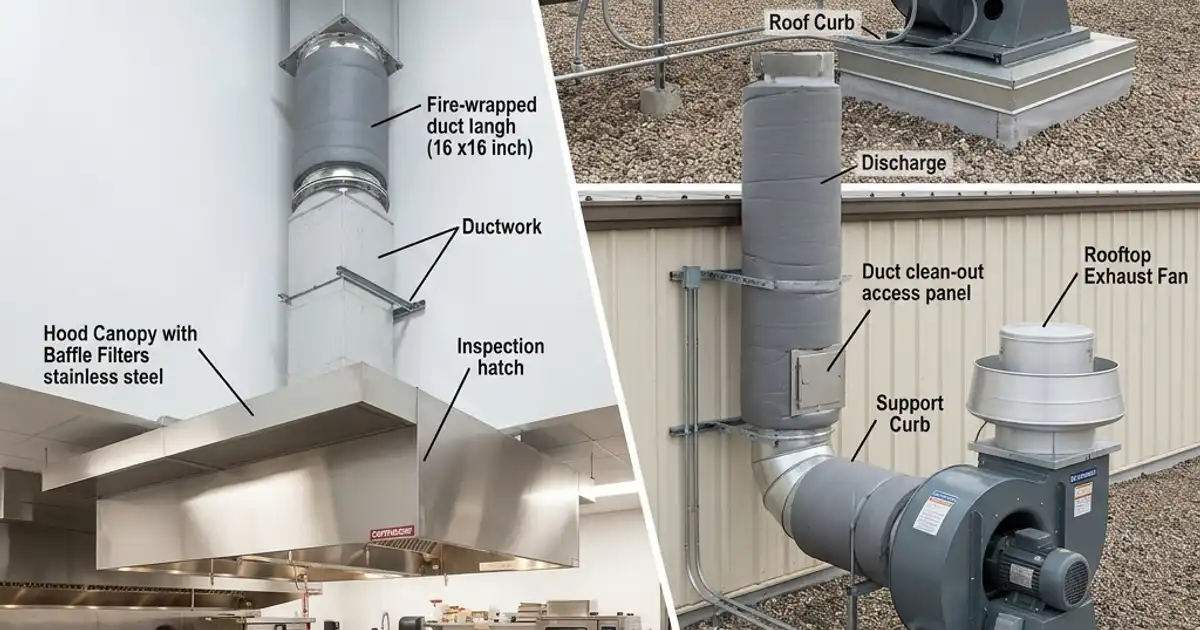
Commercial kitchen exhaust systems fall into two main categories: Type I hoods for grease-producing cooking (requiring NFPA 96 -- the National Fire Protection Association standard for commercial kitchen ventilation -- compliant cleaning) and Type II hoods for heat and steam only. Understanding your system type determines your cleaning requirements and schedule. Whether you are operating a full-service restaurant, a hotel banquet kitchen, or a school cafeteria, knowing how each component of your exhaust system works helps you maintain compliance, control fire risk, and keep your kitchen operating efficiently. Use our hood cleaner directory to find a certified professional for any service described in this guide.
1. Type I vs Type II Hoods
The most fundamental distinction in commercial kitchen ventilation is between Type I and Type II hoods. A Type I hood is a grease hood engineered to capture grease-laden vapors produced by cooking equipment such as fryers, charbroilers, griddles, ranges, and woks. Because grease accumulates inside these systems, NFPA 96 mandates scheduled professional cleaning and requires an integrated fire suppression system. A Type II hood -- sometimes called a condensate hood -- is designed only to remove heat, moisture, and odors from equipment that does not produce grease, such as ovens, steamers, proofers, and commercial dishwashers. Type II hoods do not require grease duct cleaning and are not subject to NFPA 96 fire suppression requirements.
Installing the wrong hood type for your equipment is a serious code violation. A Type II hood over a charbroiler, for example, will allow grease to accumulate in ductwork not designed for it, creating an extreme fire hazard. Always confirm your hood classification with a certified technician. See our NFPA 96 compliance guide for the full regulatory context.
| Feature | Type I Hood | Type II Hood |
|---|---|---|
| Application | Grease-producing cooking equipment | Heat, steam, and odor only |
| Grease Producing | Yes | No |
| NFPA 96 Required | Yes | No |
| Cleaning Frequency | Monthly, quarterly, semi-annual, or annual (per NFPA 96) | No grease cleaning required |
| Fire Suppression Required | Yes | No |
Source: NFPA 96, Standard for Ventilation Control and Fire Protection of Commercial Cooking Operations.
2. Components of an Exhaust System
A commercial kitchen exhaust system is not a single appliance but a series of interconnected components that work together to capture, contain, and expel cooking byproducts from the kitchen. Each component plays a specific role, and failure or contamination in any one part can compromise the entire system. Professional hood cleaners are required by NFPA 96 to clean and inspect each of these components during a service visit.
- Hood canopy -- the large stainless steel or painted steel enclosure mounted above cooking equipment. Its job is to capture rising grease-laden air and direct it toward the filters and duct opening. The interior surfaces of the canopy accumulate grease and must be thoroughly cleaned at every service.
- Grease filters -- mesh or baffle-style panels mounted in the hood opening that trap grease droplets before they enter the ductwork. Filters are the first line of defense and require frequent cleaning or replacement.
- Ductwork -- the enclosed metal channel that carries exhaust air from the hood to the exterior of the building. Grease coats the interior walls of the duct and must be cleaned to prevent fire hazard and maintain airflow.
- Exhaust fan -- typically mounted on the rooftop, the exhaust fan draws air through the entire system. Fan blades accumulate grease and must be cleaned to maintain suction capacity and prevent imbalance.
- Rooftop grease containment unit -- a catch box or containment tray mounted beneath the exhaust fan to prevent grease from dripping onto the roof surface. Required under NFPA 96 and many local codes to prevent environmental contamination and roof damage.
For a professional to perform a compliant cleaning, every section of this system must be accessible. This is why NFPA 96 requires adequate access panels to be installed in ductwork runs that cannot otherwise be reached. If your system lacks access panels, your hood cleaner is required to note the deficiency in their service report.
3. Grease Filters
Grease filters are the most frequently serviced component of a Type I exhaust system. They sit at the junction between the hood canopy and the duct opening, and their primary purpose is to remove grease from the air stream before it reaches the ductwork. There are two common types used in commercial kitchens.
Baffle Filters
Baffle filters are the industry standard for commercial kitchens. They consist of a series of angled metal baffles that force air to make sharp directional changes. As the air changes direction, grease droplets cannot follow the same path and fall into a collection trough below the filter. Baffle filters are highly effective, durable, and dishwasher-safe. Most fire codes and insurance carriers require baffle filters over mesh filters in grease-producing environments due to their superior fire resistance and grease capture efficiency.
Mesh Filters
Mesh filters use a woven metal screen to catch grease particles. While they were common in older installations, mesh filters are no longer preferred for high-volume grease environments because they clog quickly, restrict airflow, and present a higher fire risk when saturated with grease. If your system still uses mesh filters, consider upgrading to baffles -- consult a professional through our filter replacement service page.
Cleaning and Replacement Frequency
Grease filters in high-volume kitchens should be removed and cleaned every one to two weeks, not just at scheduled hood cleaning intervals. Many kitchen managers clean filters in a commercial dishwasher overnight. Filters that are bent, torn, warped, or no longer seat properly in the hood frame must be replaced immediately, as gaps allow grease-laden air to bypass the filter entirely and enter the ductwork unfiltered. See our filter replacement service listings to find technicians who stock replacement baffles for most commercial hood brands.
4. Ductwork
The grease duct is arguably the most hazardous component of a commercial kitchen exhaust system. It is a fully enclosed metal channel -- typically constructed from 16-gauge black steel or stainless steel -- that runs from the hood opening through walls, ceilings, and roof penetrations to the exhaust fan. Because the duct is hidden inside building cavities, grease accumulation inside it poses a serious fire risk that is not visible during routine kitchen inspections.
Materials and Construction
NFPA 96 requires grease ducts to be constructed from a continuous, liquid-tight weld with no seams or joints where grease could leak. The duct must maintain a minimum clearance from combustible materials and must be enclosed in a grease duct enclosure system unless it meets specific clearance requirements. Flexible ductwork is not permitted for grease duct applications in most jurisdictions.
Access Panels
NFPA 96 requires access panels to be installed at intervals along horizontal duct runs and at every change in direction so that cleaners can reach all interior surfaces. If your ductwork was installed without adequate access panels, your hood cleaner is required to document inaccessible sections on their service report. Portions of the duct that cannot be cleaned must be noted as a deficiency. Adding access panels is a one-time modification that brings your system into compliance and allows complete cleaning going forward.
Grease Buildup and Fire Risk
Grease deposits inside a duct can ignite at temperatures as low as 400 degrees Fahrenheit. A duct fire is extremely dangerous because it travels rapidly through the hidden channel, spreading fire into wall and ceiling cavities throughout the building. Regular grease duct cleaning removes these deposits before they reach dangerous levels. The frequency of duct cleaning is governed by the same NFPA 96 schedule as hood cleaning -- the entire system is cleaned in a single service visit. Consult our hood cleaning frequency guide to determine the correct interval for your operation.
5. Exhaust Fans
The exhaust fan is the engine of your ventilation system. Typically mounted on the rooftop directly above or near the duct termination point, it creates the negative pressure that draws cooking byproducts up through the filters, through the ductwork, and out of the building. Without a properly functioning exhaust fan, the entire system loses effectiveness regardless of how clean the hood and ductwork are.
Types of Exhaust Fans
Commercial kitchen exhaust fans come in two primary configurations. Upblast fans discharge exhaust air straight up into the atmosphere and are the most common type used in restaurant and institutional kitchen applications. They are designed to throw grease-laden discharge away from the rooftop surface and are easier to clean than other designs. Utility fans (also called in-line fans) are mounted within the duct run rather than at the termination point and are used when rooftop mounting is not practical. Each type requires the same cleaning attention, but access methods differ.
Fan Maintenance and Cleaning
Grease accumulates on fan blades, the fan housing, the motor mounting plate, and the fan curb. Heavy grease buildup on fan blades creates rotational imbalance, which causes vibration, bearing wear, and eventually premature motor failure. A clean fan operates more quietly, moves more air per watt of electricity consumed, and lasts significantly longer. During a full exhaust system cleaning, the fan blades are hand-scraped and degreased, the housing interior is cleaned, and the grease containment tray beneath the fan is emptied and cleaned. Our exhaust fan cleaning service listings connect you with technicians who perform rooftop fan work as part of a complete system cleaning or as a standalone service when a fan requires attention between scheduled cleanings.
6. Makeup Air Systems
Every cubic foot of air that your exhaust fan removes from the kitchen must be replaced with fresh air from outside -- this replacement air is called makeup air. Without an adequate makeup air supply, the kitchen becomes negatively pressurized relative to adjacent spaces. Negative pressure causes doors to swing open or shut on their own, makes the kitchen uncomfortably drafty, reduces hood capture velocity (allowing smoke and grease to escape into the dining room), and can cause gas appliances to back-draft combustion gases into the kitchen.
How Makeup Air is Supplied
Makeup air can be introduced in several ways. Short-circuit supply air is delivered directly into the hood face or through slots in the hood canopy, reducing the amount of conditioned room air that the hood must capture. Perforated ceiling diffusers distribute makeup air throughout the kitchen space. Some systems supply a portion of the makeup air directly to the cooking zone through low-velocity slots in the front of the hood. Each approach has tradeoffs for energy efficiency, cooking conditions, and grease capture performance. A mechanical engineer or certified hood specialist should design or evaluate your makeup air configuration when installing or replacing equipment.
Why Makeup Air Matters for Compliance
An improperly balanced makeup air system can cause a technically clean hood to fail inspection. If the hood cannot maintain adequate face velocity to capture all smoke and grease from the cooking surface, the fire marshal may cite the system as non-compliant regardless of cleaning frequency. NFPA 96 requires that the exhaust and supply air systems be designed and maintained together as an integrated system. If you are experiencing smoke spillage from your hood despite regular cleaning, a makeup air evaluation should be part of your troubleshooting process.
7. Choosing the Right System
Selecting the correct exhaust system for a new commercial kitchen installation -- or evaluating whether an existing system is correctly sized -- requires balancing several factors. An undersized hood leaves cooking emissions uncaptured; an oversized system wastes energy and can create uncomfortable drafts at the cooking line.
Equipment Type and Heat Load
The single most important factor in hood sizing is the type and BTU output of the cooking equipment beneath it. Charbroilers and open-flame equipment generate the highest thermal and grease loads and require higher exhaust volumes than ovens or steamers. NFPA 96 and ASHRAE Standard 154 both provide guidance on calculating required exhaust rates by equipment type. A mechanical engineer familiar with commercial kitchen ventilation should perform these calculations for any new installation.
Hood Overhang and Geometry
The hood must extend beyond the cooking equipment on all sides to capture the thermal plume rising from the cooking surface. Typical overhang requirements are 6 inches on the front and sides for wall-mounted hoods. Insufficient overhang is a common cause of smoke spillage and is a code violation under NFPA 96. Island hoods (suspended over equipment in the center of a kitchen) require greater overhang than wall-mounted hoods because the thermal plume is more susceptible to cross-drafts.
Energy Efficiency and Controls
Modern exhaust systems benefit significantly from demand-controlled kitchen ventilation (DCKV), which uses sensors to modulate fan speed based on actual cooking activity rather than running at full speed continuously. DCKV systems can reduce exhaust fan energy consumption by 40 to 70 percent in kitchens that have variable cooking loads throughout the day. Many utility companies offer rebates for DCKV installations. When specifying a new system or retrofitting an existing one, ask your equipment supplier and your certified hood cleaning professional whether DCKV is appropriate for your operation.
Frequently Asked Questions
Frequently Asked Questions
Ready to Schedule Your Exhaust System Cleaning?
Find an NFPA 96-compliant hood cleaning professional in your area. Browse by location, certification, and service type.
Find a Hood Cleaner Near YouRelated Guides
- NFPA 96 Compliance Guide for Restaurant Owners — Full breakdown of code requirements, inspection standards, and penalties.
- Hood Cleaning Frequency Guide — Monthly, quarterly, semi-annual, and annual schedules by kitchen type.
- Grease Duct Cleaning Services — Find certified duct cleaning professionals in your area.
- Exhaust Fan Cleaning Services — Rooftop fan cleaning and maintenance by certified technicians.
- Filter Replacement Services — Baffle and mesh filter replacement for commercial hoods.
- All Hood Cleaning Guides — Browse the full library of guides for kitchen operators and managers.