NFPA 96 Compliance Guide: What Restaurant Owners Must Know in 2026
NFPA 96 (the National Fire Protection Association standard governing commercial kitchen exhaust systems) requires all commercial kitchens to maintain regular professional hood cleaning on a schedule based on cooking volume. Non-compliance can result in fines, forced closures, and voided insurance policies. This comprehensive guide covers everything restaurant owners, facility managers, and food service operators need to know about meeting NFPA 96 requirements in 2026, including the latest code updates, enforcement practices, and how to find a qualified hood cleaning company in your area.
What Is NFPA 96?
NFPA 96, officially titled “Standard for Ventilation Control and Fire Protection of Commercial Cooking Operations,” is the national fire safety code that governs the design, installation, operation, inspection, and maintenance of all commercial kitchen exhaust systems in the United States. First published in 1961, this standard has been updated regularly to reflect advances in kitchen technology, fire suppression systems, and lessons learned from commercial kitchen fires.
The scope of NFPA 96 covers every component of the kitchen exhaust system, from the cooking appliances and hood canopy to the exhaust ductwork, fans, and rooftop termination. It also addresses fire suppression systems, grease containment, access for cleaning and inspection, and the clearance requirements between cooking equipment and combustible materials.
NFPA 96 applies to all commercial cooking operations that produce grease-laden vapors. This includes restaurants, hotels, hospitals, schools, catering operations, food trucks, institutional kitchens, grocery store delis, convenience store food service areas, and any other establishment where food is prepared commercially. If your kitchen has a hood and exhaust system, NFPA 96 almost certainly applies to you.
A key concept in NFPA 96 is the Authority Having Jurisdiction (AHJ). The AHJ is the organization, office, or individual responsible for enforcing NFPA 96 requirements in your area. In most cases, the AHJ is your local fire marshal or fire department, but it can also be a state fire marshal, building code official, insurance company, or health department. The AHJ has the authority to inspect your kitchen, require corrective action, and impose penalties for non-compliance. Understanding who your AHJ is and what they require is the first step toward maintaining compliance.
NFPA 96 Cleaning Frequency Requirements
According to NFPA 96 Section 11.4, the entire exhaust system must be inspected and cleaned on a schedule based on the type and volume of cooking. The standard defines four cleaning frequency tiers. Failure to adhere to these schedules is one of the most common NFPA 96 violations and a leading cause of commercial kitchen fires. For a more detailed breakdown, see our hood cleaning frequency guide.
| Frequency | Kitchen Type | Examples |
|---|---|---|
| Monthly | High-volume cooking, 24-hour operations, solid fuel appliances | 24/7 diners, charbroiler-heavy restaurants, wood-fired pizza, barbecue joints, wok cooking operations |
| Quarterly | Standard commercial cooking, moderate grease production | Full-service restaurants, fast food chains, hotel kitchens, hospital cafeterias |
| Semi-Annually | Moderate-volume cooking, limited grease production | Churches, day camps, seasonal banquet facilities, community centers |
| Annually | Low-volume cooking, minimal grease production | Seasonal kitchens, low-volume church kitchens, concession stands with limited cooking |
It is important to note that these are minimum requirements. Your AHJ may require more frequent cleaning based on local conditions, inspection findings, or the specific characteristics of your operation. Many insurance companies also mandate more frequent cleaning as a condition of coverage. A typical professional hood cleaning service costs between $400 and $600 for a standard restaurant system, making quarterly compliance an affordable investment compared to the risks of non-compliance.
2025 NFPA 96 Updates
The 2025 edition of NFPA 96 introduced several significant changes that affect commercial kitchen operations across the country. These updates reflect the industry’s evolving understanding of fire risks and the growing need for accountability in exhaust system maintenance. Here are the key changes every restaurant owner needs to know:
- 16+ hour operations now require monthly cleaning: The 2025 edition mandates that any commercial kitchen operating 16 or more hours per day must follow the monthly cleaning schedule, regardless of cooking type. Previously, only solid fuel cooking and very high-volume operations triggered the monthly requirement. This change affects many full-service restaurants, 24-hour establishments, and large hotel kitchens.
- UL-300 fire suppression systems required with no grandfathering: All commercial kitchens must now have UL-300 listed fire suppression systems. Older wet chemical or dry chemical systems that do not meet the UL-300 standard must be replaced. There is no grandfathering provision, meaning even existing installations must be upgraded. Learn more about fire suppression inspection services.
- Digital documentation required: The 2025 update requires that all cleaning records, inspection reports, and compliance documentation be maintained in digital format in addition to any physical certificates or stickers. This ensures records are preserved and readily accessible during inspections.
- Additional access panels required: Exhaust duct systems must now have sufficient access panels to allow thorough cleaning and inspection of all duct sections. The updated standard specifies minimum access panel sizes and maximum spacing to eliminate hard-to-reach areas where grease can accumulate undetected.
- New rooftop grease containment standards: The 2025 edition introduces stricter requirements for rooftop grease containment around exhaust fan discharge points. These standards aim to prevent grease from contaminating rooftop surfaces, clogging drainage systems, and creating environmental hazards.
These changes took effect upon publication and adoption by local jurisdictions. Enforcement timelines vary by state and municipality, so contact your AHJ to confirm which edition they have adopted and any applicable transition periods.
How NFPA 96 Is Enforced
NFPA 96 enforcement works through a combination of fire marshal inspections, insurance company audits, and AHJ oversight. Understanding the enforcement landscape in your jurisdiction is critical because penalties, inspection frequency, and documentation requirements vary significantly from state to state and even city to city.
Fire marshals are the primary enforcement agents in most jurisdictions. They conduct scheduled inspections (typically annually or semi-annually) and unannounced spot checks. During an inspection, the fire marshal will examine the cleanliness of the hood, filters, ductwork, and fan. They will check for a current cleaning sticker on the hood, review your cleaning certificates and records, verify the fire suppression system is up to date, and look for any code violations related to clearances, access panels, or grease containment.
Insurance companies represent a second layer of enforcement. Most commercial property and liability insurers require proof of NFPA 96 compliance as a condition of coverage. They may request copies of your cleaning certificates, fire suppression inspection reports, and maintenance logs. If a fire occurs and you cannot demonstrate compliance, your insurer may deny the claim entirely, leaving you personally liable for all damages.
Some states are known for particularly strict enforcement. New York (through the FDNY) maintains one of the most rigorous inspection programs in the country, with frequent unannounced inspections and steep fines for violations. California has adopted stringent state-level fire codes that exceed NFPA 96 minimums in several areas. Texas and Florida also maintain active enforcement programs with regular inspection cycles and meaningful penalties for non-compliance.
Penalties for Non-Compliance
The consequences of failing to comply with NFPA 96 are severe and can threaten the financial viability of your entire operation. Penalties fall into three main categories: monetary fines, operational shutdowns, and insurance consequences.
Monetary Fines
Fines for NFPA 96 violations typically range from $500 to $10,000 or more per violation, depending on the jurisdiction and severity. First-time offenders in many areas receive a warning with a corrective action deadline, but repeat violations trigger escalating fines. In cities like New York, a single violation can result in fines of $2,500 or more, and multiple violations found during a single inspection can compound quickly. Some jurisdictions also impose daily fines for each day a violation remains uncorrected.
Forced Closure
In cases of serious or imminent fire hazard, the AHJ has the authority to order an immediate shutdown of your cooking operations. This can happen during a routine inspection if the inspector finds heavy grease buildup, a non-functioning fire suppression system, or other conditions that pose an immediate risk. Your kitchen cannot reopen until all violations are corrected and a follow-up inspection is passed. The lost revenue from even a few days of closure can far exceed the cost of regular hood cleaning services.
Insurance Claim Denials
Perhaps the most financially devastating consequence is insurance claim denial. If a grease fire occurs in your kitchen and your insurer determines that you were not in compliance with NFPA 96 at the time of the fire, they can deny your claim. This means you would be personally responsible for all property damage, business interruption losses, liability claims from injured employees or customers, and any environmental cleanup costs. A single kitchen fire can result in damages exceeding $100,000, making the $400 to $600 cost of quarterly hood cleaning a minor expense by comparison. For pricing details, see our hood cleaning cost guide.
What a Proper Hood Cleaning Includes
A professional hood cleaning that meets NFPA 96 standards is a thorough, multi-step process that typically takes 2 to 4 hours for a standard restaurant system. Understanding what the process involves helps you evaluate whether your cleaning company is performing a compliant service. Here is what to expect:
- Pre-cleaning inspection: The technician inspects the entire exhaust system, documenting existing conditions with photographs. They check the fire suppression system, note any damage or deficiencies, and identify areas of heavy grease accumulation.
- Area preparation: The kitchen area is covered with plastic sheeting and floor protection to prevent grease and cleaning solution from contaminating food preparation surfaces, equipment, and floors. Gas and electrical connections to cooking appliances are secured.
- Filter removal and cleaning: All hood filters (baffle filters, mesh filters) are removed and soaked in a hot degreasing solution or cleaned with pressure washing equipment.
- Hood interior cleaning: The interior surfaces of the hood canopy are scraped and pressure washed to remove all accumulated grease. This includes the hood plenum, the area behind the filters, and all interior surfaces.
- Ductwork cleaning: The entire length of exhaust ductwork is cleaned through access panels. Technicians use scrapers, brushes, and pressure washing equipment to remove grease from horizontal and vertical duct runs. This is the most critical step because grease-laden ductwork is the primary fuel source in kitchen exhaust fires.
- Fan cleaning: The exhaust fan on the rooftop is disassembled, cleaned, and inspected. The fan housing, blades, and motor assembly are degreased. The fan hinge kit and grease containment system are also cleaned and inspected.
- Post-cleaning inspection and documentation: After cleaning, the technician performs a final inspection, takes post-cleaning photographs, and issues a cleaning certificate. A service sticker showing the date of cleaning and next scheduled service is affixed to the hood in a visible location.
According to NFPA 96, bare metal must be visible after a proper cleaning. If your hood cleaner is leaving visible grease residue on any surface, they are not meeting the standard. The cleaning should cover every component from the hood canopy to the rooftop fan, with no sections skipped or inaccessible areas left uncleaned.
Choosing a Compliant Hood Cleaner
Selecting the right hood cleaning company is one of the most important decisions you can make for NFPA 96 compliance. Not all hood cleaners deliver the same quality of service, and hiring an unqualified company can leave you exposed to fire risks and compliance failures even though you paid for a cleaning. Here are the key factors to evaluate:
- IKECA certification: The International Kitchen Exhaust Cleaning Association (IKECA) is the leading industry certification body. IKECA-certified technicians have passed examinations on NFPA 96 requirements, proper cleaning methods, and fire safety. While not legally required in every jurisdiction, IKECA certification is the strongest indicator of a qualified cleaner. Fire marshals and insurance companies increasingly prefer or require IKECA-certified providers. Read our IKECA certification guide for more details.
- Insurance coverage: Your hood cleaner should carry general liability insurance (minimum $1 million), workers compensation insurance, and ideally a pollution liability policy. Request certificates of insurance before work begins. If an uninsured cleaner causes damage to your property or a worker is injured on your premises, you may be held liable.
- Before-and-after documentation: A reputable company will provide photographic documentation of the system before and after cleaning, a detailed cleaning certificate listing all areas cleaned, and a service sticker for the hood. If a company cannot provide these, consider it a red flag.
- Questions to ask: Are your technicians IKECA certified? Do you carry general liability and workers compensation insurance? Will you provide before-and-after photos? Do you clean the entire system from hood to fan? Will you issue a cleaning certificate and apply a service sticker? Can you provide references from other restaurants in my area?
For a complete evaluation checklist, see our guide on how to choose a hood cleaning company, or find certified hood cleaners in your area using our directory.
Documentation and Records
Proper documentation is essential to proving NFPA 96 compliance. Fire marshals require evidence that your exhaust system has been cleaned on schedule, and your insurance company will demand records if a claim is filed. The 2025 edition of NFPA 96 strengthened documentation requirements by mandating digital record-keeping in addition to traditional physical certificates.
According to NFPA 96, you must maintain the following documentation:
- Cleaning certificates: Issued by the hood cleaning company after each service. These should include the date of service, the name and certification number of the technician, a list of all system components cleaned, and any deficiencies noted.
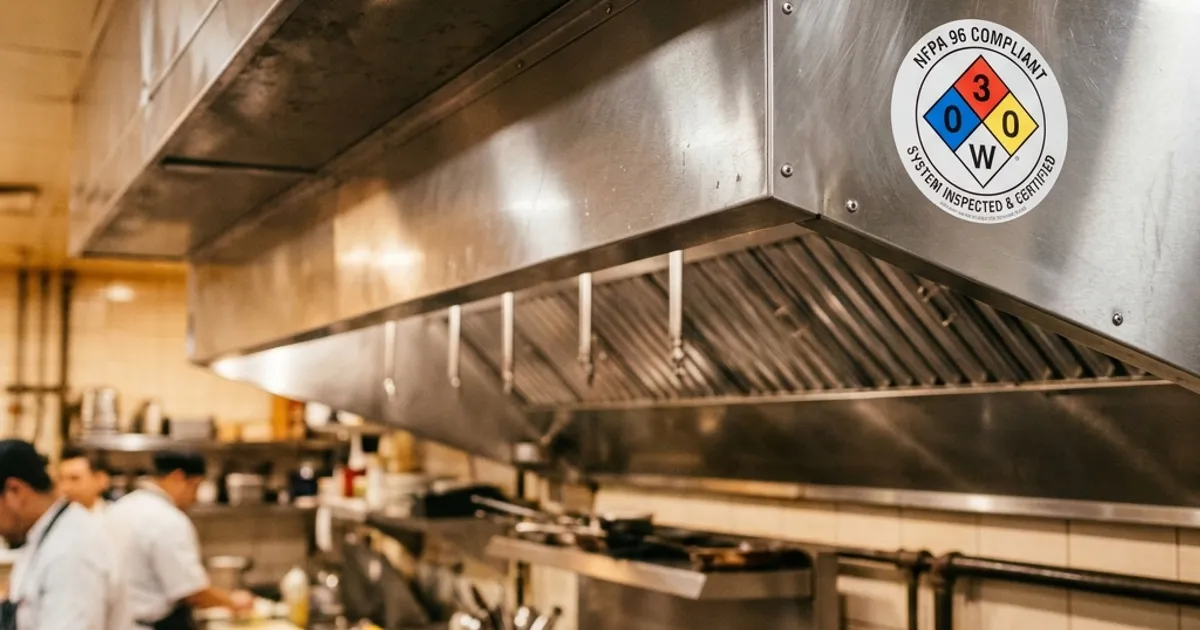
- Service stickers: A visible sticker affixed to the hood canopy showing the date of last cleaning, the company name, and the next scheduled cleaning date. Fire marshals check for this sticker during inspections.
- Before-and-after photographs: Visual documentation of the system condition before and after cleaning. This provides evidence that the cleaning was thorough and that bare metal was achieved.
- Fire suppression inspection reports: Semi-annual inspection reports for your fire suppression system, including the condition of nozzles, links, tanks, and actuation mechanisms.
- Deficiency correction records: If a cleaning or inspection reveals a deficiency (such as a damaged access panel, missing grease cup, or malfunctioning fan), you must document that the deficiency was corrected and by whom.
- Digital backups (2025 requirement): All of the above records must now be maintained in digital format. This can be as simple as scanned copies stored in cloud storage or as sophisticated as a dedicated compliance management platform.
Keep all records for a minimum of three years, though many insurance companies and AHJs recommend retaining records for the full duration of your tenancy or ownership. For a complete breakdown of documentation requirements and best practices, see our hood cleaning documentation guide.
Frequently Asked Questions
Ready to Get Compliant?
Find hood cleaning companies in your area. Compare quotes, read reviews, and schedule your next cleaning today.
Find Hood Cleaners Near YouRun a hood cleaning company?
Claim your free listing, or add your business if you're not listed yet. Verification is free with your current COI, and verified businesses can be included when restaurants request quotes.
Claim or add your listing →