Grease Trap vs Grease Interceptor: What Your Kitchen Needs
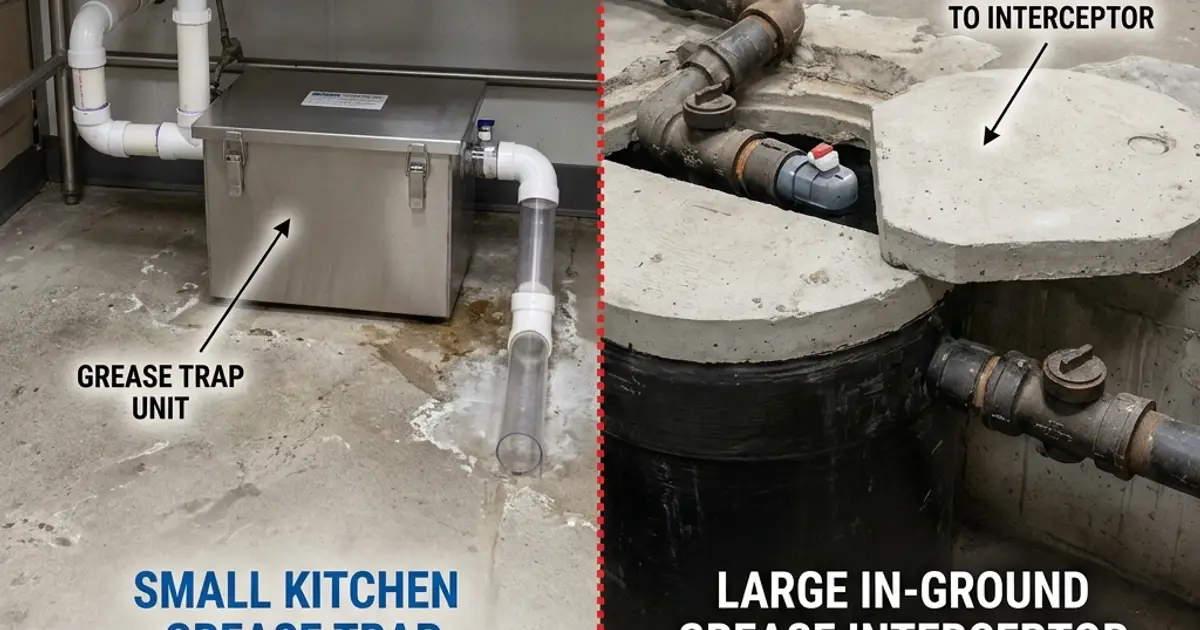
Grease traps and grease interceptors both prevent fats, oils, and grease (FOG) from entering the sewer system, but they differ in size, capacity, and maintenance requirements. Small restaurants typically use grease traps (under 100 GPM -- gallons per minute), while high-volume operations need grease interceptors (100--500+ GPM). Choosing the wrong device -- or failing to maintain the right one -- can result in sewer violations, costly back-ups, and code enforcement action. This guide breaks down how each device works, when each is required, and how to decide which one fits your commercial kitchen.
1. What Is a Grease Trap?
A grease trap -- sometimes called a grease recovery device or hydromechanical grease interceptor -- is a plumbing device installed inline between a kitchen's drain lines and the sanitary sewer. Its purpose is to capture FOG before it cools and solidifies inside municipal pipes, where it can cause blockages and sanitary sewer overflows (SSOs).
How It Works
Wastewater from sinks, dishwashers, and floor drains flows into the trap's inlet. Inside the trap, the flow slows dramatically, allowing FOG -- which is less dense than water -- to float to the surface while food solids settle to the bottom. The clarified wastewater in the middle layer exits through the outlet into the sewer. Over time, the accumulated FOG layer and settled solids must be removed before they reach a level that lets grease escape through the outlet.
Size and Capacity
Grease traps are compact, typically ranging from 5 to 100 gallons in total capacity, and are rated by flow rate in GPM. A standard under-sink grease trap might be rated at 20--50 GPM and handle the drainage from one or two sinks. Larger floor-mounted units can handle 75--100 GPM and serve multiple fixtures. Their compact footprint makes them suitable for smaller kitchens or locations where outdoor installation is not possible.
Typical Installations
Grease traps are most commonly installed in small to medium-sized food service operations: independent restaurants, cafes, food trucks with fixed plumbing, deli counters, and small cafeterias. They are almost always located indoors -- under a prep sink, inside a utility closet, or in a floor pit beneath the kitchen. Their accessibility makes inspection and cleaning straightforward, but it also means FOG accumulates quickly and requires more frequent service than larger interceptors.
2. What Is a Grease Interceptor?
A grease interceptor is a large-capacity FOG removal device, typically a buried concrete or fiberglass tank installed outside the building. Unlike a grease trap, which handles flow from one or a few fixtures, a grease interceptor receives wastewater from the entire kitchen -- or even multiple kitchens in a shared facility.
How It Works
The operating principle is the same as a grease trap: slow the flow so that FOG floats to the top and solids sink to the bottom. However, because an interceptor holds hundreds or thousands of gallons, it has much greater retention time -- the period during which wastewater sits in the tank. Longer retention time means more complete FOG separation and a reduced risk of FOG breakthrough into the sewer. Interceptors typically have multiple baffled chambers to further improve separation efficiency.
Size and Capacity
Grease interceptors are rated at 100 GPM and above, with common sizes ranging from 500 to 2,000 gallons and large installations exceeding 5,000 gallons. Sizing is calculated based on the total wastewater flow rate from all connected fixtures, typically using formulas in the International Plumbing Code (IPC) or Uniform Plumbing Code (UPC). A large hotel kitchen or hospital cafeteria might require a 1,500-gallon interceptor to handle peak-hour drainage loads.
When Interceptors Are Required
Most local plumbing codes and municipal pretreatment programs require grease interceptors for any food service establishment above a minimum flow rate threshold -- commonly 50--100 GPM. New construction is almost always required to install a full interceptor. High-volume operations such as hotel banquet kitchens, hospital food services, university dining halls, and large chain restaurants invariably need interceptors. Some jurisdictions prohibit grease traps entirely for commercial food service and mandate interceptors for all new permits. Always verify requirements with your local authority having jurisdiction (AHJ) before installation. For broader compliance context, see our NFPA 96 compliance guide.
3. Side-by-Side Comparison
The table below summarizes the key differences between grease traps and grease interceptors across the factors that matter most when choosing a FOG control device for your commercial kitchen.
| Factor | Grease Trap | Grease Interceptor |
|---|---|---|
| Size | Small -- 5 to 100 gallons; fits under a sink or in a floor pit | Large -- 500 to 5,000+ gallons; buried outdoor tank |
| Flow Capacity | Under 100 GPM; typically 20--75 GPM | 100--500+ GPM; handles entire kitchen drainage |
| Installed Cost | $300--$2,500 installed | $5,000--$30,000+ installed (includes excavation) |
| Maintenance Frequency | Every 1--4 weeks for high-volume; monthly to quarterly for low-volume | Every 1--3 months depending on volume and local code |
| Installation Location | Indoors -- under sink, utility room, or floor pit | Outdoors -- buried in ground near building |
| Best For | Small cafes, delis, food trucks, retrofit situations | Full-service restaurants, hotels, hospitals, chains |
| Service Cost (per visit) | $75--$300 per cleaning | $200--$800 per pump-out |
Cost ranges are estimates for U.S. markets as of 2026. Actual costs vary by region, access, and tank size. Contact providers in our cleaner directory for local quotes.
4. Local Regulations
Grease trap and interceptor requirements are governed by a patchwork of federal, state, and local rules. Understanding which codes apply to your operation is essential before you install or upgrade any FOG control device.
Plumbing Codes
The two primary model plumbing codes used across the U.S. are the International Plumbing Code (IPC) and the Uniform Plumbing Code (UPC). Both include detailed provisions for grease trap and interceptor sizing, installation, and location. Most states adopt one of these codes with local amendments. Your state's plumbing board and your local municipality may have additional requirements that go beyond the model code. A licensed plumber familiar with your jurisdiction should handle any new installation or upgrade.
Municipal Pretreatment Programs
Beyond plumbing codes, many cities and counties operate industrial pretreatment programs under the Clean Water Act. These programs regulate what food service establishments can discharge into the sanitary sewer and set specific FOG limits (often 100--300 mg/L). Facilities that exceed FOG limits face surcharges, fines, and mandatory upgrades. Your local publicly owned treatment works (POTW) -- typically the city water or sewer authority -- enforces these rules and may require you to register your grease device, submit maintenance logs, and pass periodic inspections.
Sizing Requirements
Grease interceptors must be properly sized for your kitchen's wastewater flow rate. Undersized devices allow FOG to break through into the sewer. The IPC sizing method calculates required capacity based on the number of drainage fixture units (DFUs) connected to the interceptor, while the UPC uses a flow rate calculation method. Your plumber will perform these calculations and submit them for permit review. Improperly sized devices may be rejected at inspection or cited for violations after installation.
Inspection Schedules
Many municipalities conduct periodic inspections of grease traps and interceptors -- commonly annually or semi-annually. Inspectors verify that the device is properly maintained, that FOG depth does not exceed the 25% rule, and that cleaning records are current. Some jurisdictions use electronic manifest systems that require waste haulers to submit digital records of every pump-out. Keep your maintenance logs organized and readily accessible. For guidance on record-keeping across all commercial kitchen compliance areas, see our broader guides library.
5. Maintenance Requirements
Regular maintenance is not optional -- it is the difference between a functioning FOG control system and a sewer violation waiting to happen. Both grease traps and interceptors require scheduled cleaning, but the approach differs significantly between the two device types.
Grease Trap Cleaning Frequency
The standard rule for grease trap cleaning is the 25% rule: clean the trap when the combined depth of the floating FOG layer and the settled solids layer equals 25% or more of the trap's total liquid depth. In practice, a busy restaurant kitchen can reach this threshold in one to four weeks. Many local codes set a minimum cleaning frequency -- often every 30, 60, or 90 days -- regardless of actual FOG depth. Track your trap's condition by measuring at each cleaning so you can calibrate your cleaning schedule to actual accumulation rates.
Grease Interceptor Pump-Out Frequency
Grease interceptors are typically pumped out every one to three months for active food service operations, though some lower-volume operations qualify for quarterly or semi-annual service. The same 25% rule applies, and many municipalities require a licensed waste hauler to perform the pump-out and submit a manifest documenting the volume removed and the disposal facility used. Never attempt to pump an interceptor yourself -- the waste is classified as a regulated non-hazardous waste in most states and must be handled by a licensed hauler.
Professional Service
Whether you have a grease trap or an interceptor, professional service is required. A qualified technician will pump out accumulated FOG and solids, inspect the device for cracks, broken baffles, or deteriorating seals, clean the inlet and outlet pipes, and provide a written service report. Find certified grease trap and interceptor service providers in your area through our grease trap cleaning service directory. Consistent professional maintenance also protects your kitchen exhaust system -- for related guidance, see our kitchen exhaust systems guide.
6. Choosing the Right One
Selecting between a grease trap and a grease interceptor comes down to four factors: your kitchen's volume, the applicable local code, available space, and your budget. Here is how to work through each.
Check Code Requirements First
Before evaluating anything else, contact your local building department and sewer authority. Many jurisdictions have already made this decision for you: new food service establishments are required to install a full grease interceptor, and grease traps are only permitted in limited retrofit situations. Attempting to install a grease trap where an interceptor is required will result in a failed permit inspection and a costly correction.
Assess Your Kitchen Volume
If your kitchen generates 100 GPM or more of wastewater from cooking and washing operations, you almost certainly need an interceptor. A small cafe with one prep sink and a two-bay dish sink might generate only 25--40 GPM and qualify for a grease trap. Your plumber can calculate your kitchen's peak flow rate by counting fixture units and applying the applicable sizing formula.
Consider Installation Space and Cost
Grease interceptors require outdoor space for excavation, which is not always available in urban locations. A rooftop restaurant or a kitchen in a high-rise building may be physically unable to install a buried interceptor and will need to use an alternative device -- such as an automatic grease removal device (AGRD) -- subject to local approval. Budget is also a factor: a grease interceptor installation can cost $10,000--$30,000 or more compared to $300--$2,500 for a grease trap. However, the lower upfront cost of a grease trap comes with higher ongoing maintenance frequency, which adds up over time.
Long-Term Cost Comparison
A grease trap cleaned monthly at $150 per service costs $1,800 per year in maintenance alone. A grease interceptor pumped quarterly at $400 per service costs $1,600 per year -- potentially less than frequent trap cleaning -- despite the much higher installation cost. For a high-volume restaurant that would need weekly trap cleaning, the long-term economics of a larger interceptor are often favorable once the installation is amortized. Factor both scenarios into your business plan before committing to a device type. For related cost guidance, see our hood cleaning frequency guide.
Once you have determined the correct device for your kitchen, use our directory of certified professionals to find licensed grease trap and interceptor service providers in your area.
Need Grease Trap or Interceptor Service?
Find certified FOG management professionals near you and keep your kitchen in compliance.
Find Grease Trap Cleaners